

High-performing leaders are often the people everyone counts on.
They catch what others miss. They solve problems before they escalate. They step in when something needs to get done. And somewhere along the way, being dependable can become more than a strength. It can become an expectation leaders place on themselves.
You might recognize the pattern: I should have caught that. I need to fix this. I can’t let the team down. I should be able to handle this.
That voice can fuel achievement for a long time. But when it becomes the default way you motivate yourself, the same inner critic that once pushed you forward can begin interfering with the way you lead.
The solution isn’t to stop caring, lower your standards, or avoid accountability. It’s learning to respond to yourself differently when things don’t go according to plan.
That’s where self-compassion in leadership becomes a powerful and highly practical leadership skill.
In this blog post, we’ll explore what self-compassion looks like in leadership, where the inner critic comes from, and how high-performing leaders can manage self-critical thinking without sacrificing accountability or high standards. We’ll also share practical ways to build greater resilience, respond more intentionally under pressure, and create more room for your team to learn, take ownership, and grow.
The “Superhero Cape” of High-Performing Leaders
Many successful leaders develop what we might call a superhero cape: the belief that they need to catch everything, fix everything, and never drop the ball.
It makes sense.
Maybe your ability to solve problems helped accelerate your career. Perhaps you became known as the person who could always be relied upon. Maybe you worked in an organization where jumping in, staying late, and saving the day were rewarded.
Those behaviors aren’t inherently bad. They may be rooted in genuine strengths, ambition, responsibility, and a desire to help.
The problem appears when a strength becomes an automatic response.
Instead of allowing someone else to solve a problem, you step in.
Instead of delegating, you take another task onto your plate.
Instead of viewing a mistake as information, you view it as evidence that you should have done better.
Over time, wearing the cape constantly can affect not only your own resilience but also the people around you. Team members may become hesitant to take risks, bring problems forward, or exercise their own judgment if they expect the leader to step in and fix things anyway.
Effective leadership isn’t about wearing the superhero cape all the time. It’s developing enough awareness to know when to step in and when to step back.
Where Does the Inner Critic Come From?
Your inner critic probably didn’t appear out of nowhere.
Often, it develops around something that genuinely worked.
It may originate from:
- An overused strength. You became successful because you were exceptionally detail-oriented, responsive, or good at solving problems. Eventually, that strength was pushed beyond its useful limit.
- An old pattern. A behavior that protected or rewarded you earlier in your career—or even earlier in life—continues operating in situations where it is no longer necessary.
- Something people praised. If you’ve repeatedly heard, “You’re the one we can always count on,” reliability can become connected to your sense of value.
- Your organizational culture. A workplace that celebrates heroics, constant availability, or stepping in to rescue projects can reinforce the idea that this is simply what strong leadership looks like.
Understanding the origin matters because the objective isn’t to fight your inner critic.
It’s to recognize what it’s trying to accomplish—and decide whether its advice is actually useful in the situation you’re facing now.
The Leadership Cost of an Unmanaged Inner Critic
Harsh self-criticism can sometimes feel like accountability, but constantly putting pressure on yourself can come at a cost.
When your inner critic goes unmanaged, it can affect how you think, respond, make decisions, and connect with the people around you.
Below are six common ways an unmanaged inner critic can impact your leadership:
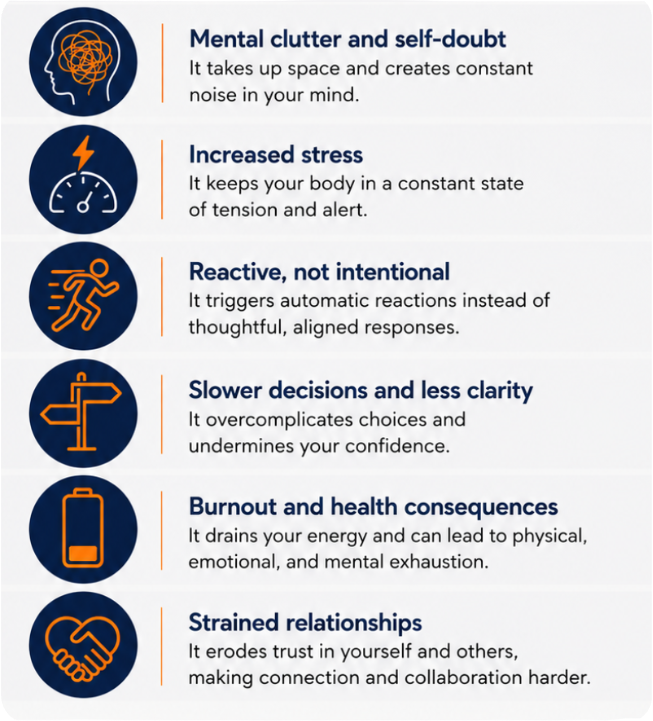
Recognizing these patterns is an important first step. The goal isn’t to eliminate your inner critic completely, but to notice when it’s taking over so you can respond with greater clarity and intention.
What Is Self-Compassion in Leadership?
Self-compassion isn’t simply “being nice to yourself.”
Researcher Dr. Kristin Neff’s framework identifies three core elements of self-compassion: self-kindness, common humanity, and mindfulness. Applied to leadership, they create a practical alternative to automatic self-criticism.
1. Self-Kindness
Self-kindness means responding to yourself with understanding rather than immediately reaching for harsh criticism.
Imagine sending an important email and realizing afterward that it contains an error.
The inner critic might respond:
How could I have been so careless?
Self-kindness doesn’t pretend the mistake didn’t happen. It sounds more like:
That happened. I’ll correct it and move forward.
The error still gets fixed. Accountability remains intact. What disappears is the unnecessary punishment surrounding it.
2. Common Humanity
Leaders sometimes treat their own mistakes as though competent people don’t make them.
Common humanity reminds us that mistakes, setbacks, uncertainty, and imperfect decisions are part of being human—and therefore part of leadership.
Consider a project that misses its target.
Instead of immediately concluding that you’re not capable enough, recognize that even accomplished leaders have projects that fall short. The question becomes less about what the setback says about you and more about what the experience can teach you.
3. Mindfulness
Mindfulness creates space between what happens and what you do next.
You might notice your chest tightening during a tense meeting. You may recognize defensiveness appearing before you’re about to answer a challenging question.
Simply naming what’s happening—I’m feeling defensive right now—can interrupt the automatic reaction long enough for you to make a more intentional choice.
That pause matters.
Leadership presence isn’t only about projecting confidence. As Leadership Coach Group has explored in its work on Executive Presence, effective presence also involves alignment, adaptability, and intentionally choosing how you show up.
Self-Compassion Does Not Mean Lowering Your Standards
This is often the biggest concern for ambitious leaders.
If I stop being hard on myself, will I become complacent?
Self-compassion does not mean:
- Letting yourself off the hook
- Making excuses
- Ignoring poor performance
- Lowering expectations
Instead, it changes what happens after you miss the mark.
You can hold yourself accountable without humiliating yourself. You can expect excellence without expecting perfection. And you can acknowledge a mistake without allowing it to become a judgment about your overall capability.
Think of it as shifting from:
High standards OR self-compassion
to:
High standards AND self-compassion.
That distinction is critical because leadership development doesn’t require perfection. It requires the ability to reflect, adjust, learn, and continue forward.
Why Self-Compassion Changes How You Lead Your Team
Self-compassion starts internally, but its impact doesn’t stay there.
Leaders who are relentlessly critical of themselves may unknowingly become highly critical of other people. Conversely, learning to create room for your own mistakes can make it easier to create productive room for someone else’s.
That doesn’t mean ignoring performance issues.
It means responding in ways that encourage ownership rather than fear.
For example, imagine a team member makes a mistake on an important project.
An automatic response might be:
“How did this happen?”
Curiosity offers a different starting point:
“Walk me through what happened. What did you notice, and what do you think we need to do next?”
The second response doesn’t eliminate accountability. It gives the employee an opportunity to think, own the problem, and participate in solving it.
This is closely connected to perspective-getting and Gateway Questions, two emotional intelligence practices Leadership Coach Group has previously explored. Moving from assumptions and judgment toward genuine curiosity can strengthen trust while improving problem-solving. Read more about Emotional Intelligence for Impactful Leadership.
3 Ways Leaders Can Practice Self-Compassion in the Moment
Self-compassion becomes useful when it’s practical enough to use during a real workday.
Here are three simple practices.
1. Use Supportive Touch
When you’re under pressure, try a small physical grounding practice: place a hand over your heart, cup one hand in the other, or gently hold your arms.
The practice is deliberately simple. The objective is to give yourself a physical signal of support before trying to reason your way through an emotionally charged moment.
2. Create a Deliberate Pause
Ask yourself:
What do I need right now?
Notice that the question isn’t What does everyone else need? or How do I fix this immediately?
Maybe you need more information.
Maybe you need reassurance.
Maybe you need five quiet minutes before responding to an email.
You can also use slow, deliberate breathing to give yourself enough space to choose your response.
Even a brief pause can interrupt an automatic reaction.
3. Treat Yourself Like Someone You Respect
Think about a mistake you’re currently criticizing yourself for.
Now imagine that a respected colleague or close friend came to you and described exactly the same situation.
What would you say to them?
Chances are, your response would combine empathy with perspective:
You made a mistake. Fix what you can, learn from it, and move forward.
Now compare that with what you’re saying to yourself.
The gap between those two responses can reveal just how much influence your inner critic has.
Try closing the gap.
What Self-Compassionate Leadership Looks Like in Practice
The real test of self-compassion isn’t whether you feel better.
It’s whether you lead better.
Over time, practicing self-compassion may look like catching your inner critic before it becomes a sharp email or reactive comment. It may mean allowing someone else to finish a task instead of jumping in. It may mean openly treating mistakes as opportunities to learn and problem-solve together.
And when people aren’t preoccupied with avoiding your reaction, they may be more willing to surface problems earlier and take greater ownership of solutions.
This kind of leadership also reinforces an authentic professional identity. Your personal brand as a leader is shaped by how consistently your values show up in your actions and interactions—not only when everything is going well, but especially when something goes wrong.
Four Questions to Ask Yourself This Week
As you think about your own leadership, consider:
1. What does my inner critic actually say?
Notice the words rather than simply experiencing the pressure they create.
2. Where did that message come from?
Was it an old success strategy, an overused strength, previous praise, or something your organization rewards?
3. Where has my “superhero cape” helped me—and where is it now getting in the way?
4. What’s one situation this week where I can notice my inner critic without automatically obeying it?
Lead With High Standards Without Carrying Everything Alone
You don’t have to choose between ambition and self-compassion. You can still expect excellence. You can still hold yourself and others accountable. You can still pursue difficult goals and deliver meaningful results. Self-compassion simply gives you another way to respond when leadership gets difficult: one that helps you recover, learn, and make your next decision with greater clarity and intention.
If you’re ready to put these ideas into practice, Leadership Coach Group’s Self-Compassion Leadership Playbook takes you deeper with reflection questions, exercises for mapping your own self-compassion framework, practical in-the-moment tools, and strategies for recognizing and working with your inner critic.
Download the Self-Compassion Leadership Playbook
Go Deeper: Ditch the Superhero Cape
Want to explore what self-compassion looks like in real-world leadership situations?
In Ditch the Superhero Cape: Self-Compassion for High-Performing Leaders, executive coach and speaker Jenn Bieri explores how self-compassion can become a practical performance tool for leaders who are used to carrying a lot.

Using the “superhero cape” metaphor, Jenn examines how the instinct to catch everything, fix everything, and never drop the ball can contribute to success—but can also fuel self-criticism, stress, and burnout.
The webinar explores how self-kindness, common humanity, and mindfulness can help leaders work differently with their inner critic without giving up high standards or accountability. Jenn also shares practical strategies for recovering from setbacks, staying grounded under pressure, and making clearer, more intentional leadership decisions.
If you’re ready to rethink when you need to wear the cape—and when it’s time to take it off—this is a great next step.
Learn More: Ditch the Superhero Cape – Self-Compassion for High-Performing Leaders
Frequently Asked Questions About Self-Compassion in Leadership
What is self-compassion in leadership?
Self-compassion in leadership is the practice of responding to your own mistakes, setbacks, and difficult emotions with self-kindness, common humanity, and mindful awareness rather than automatic self-criticism. It allows leaders to maintain accountability while responding to challenges with greater clarity and intention.
Does self-compassion make leaders less accountable?
No. Self-compassion isn’t about making excuses or lowering expectations. A leader can acknowledge a mistake, take responsibility, correct it, and learn from it without adding harsh self-judgment to the process. High standards and self-compassion can coexist.
What are the three elements of self-compassion?
The three core elements are self-kindness, common humanity, and mindfulness. Self-kindness replaces unnecessary harshness with understanding; common humanity recognizes that struggle and mistakes are part of being human; and mindfulness helps you notice your experience without immediately reacting to it.
How does an inner critic affect leadership?
An unmanaged inner critic can contribute to self-doubt, stress, reactive behavior, slower decision-making, reduced clarity, exhaustion, and strained relationships. It can also influence how leaders respond to mistakes and performance issues within their teams.
How can leaders practice self-compassion at work?
Start small. Notice when your inner critic appears, pause before responding, ask yourself what you need in the moment, use supportive physical grounding or breathing, and consider what you would say to a respected colleague facing the same situation. The goal is not to avoid action but to make your next action more intentional.
Can self-compassion improve team leadership?
Self-compassion becomes a leadership skill when it changes how you respond to other people. A leader who can pause before reacting is better positioned to approach mistakes with curiosity, allow team members to solve problems, and create room for greater initiative and ownership.
How is self-compassion connected to emotional intelligence?
Both require self-awareness and emotional regulation. Recognizing your internal reaction before acting on it creates an opportunity to choose a response based on curiosity, empathy, and intention rather than defensiveness or judgment. This complements Leadership Coach Group’s broader approach to emotionally intelligent leadership.
What’s the first step to becoming a more self-compassionate leader?
Start by noticing your inner critic without immediately trying to eliminate it. Pay attention to what it says, when it becomes loudest, and what behavior it pushes you toward. From there, practice creating a brief pause between the critical thought and your response.